Auditory Processing Disorder (APD). When the ears hear but the brain struggles.

A practical guide to understanding, diagnosis and management.
What is Auditory Processing Disorder?
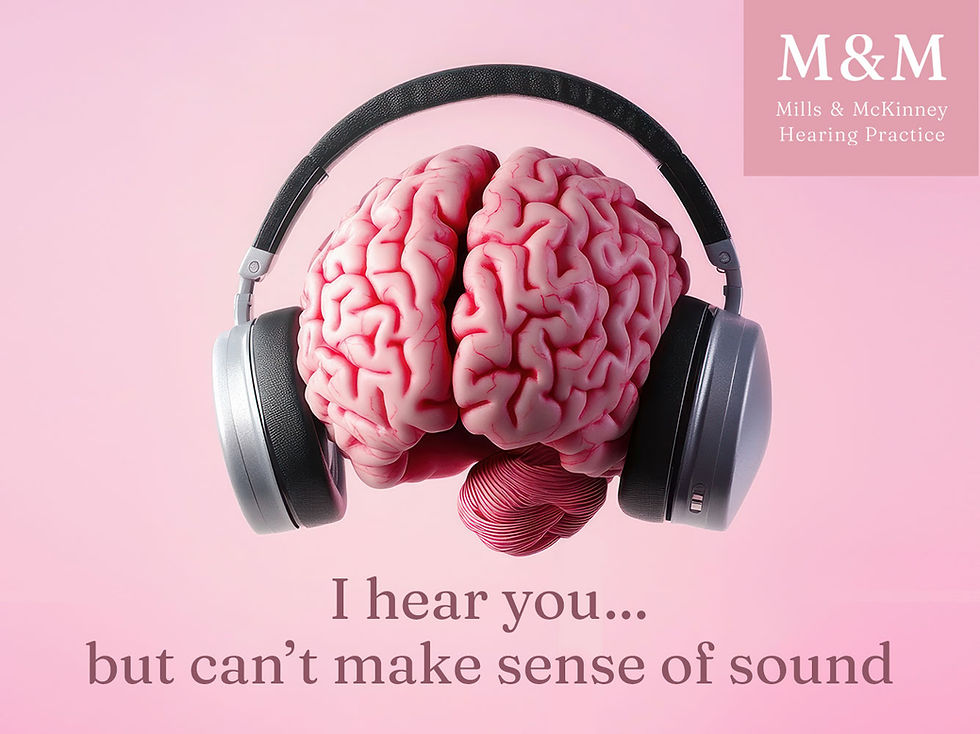
Auditory Processing Disorder (APD) is a condition where hearing is usually normal, but the brain has difficulty processing and interpreting sounds, particularly speech. APD can co-occur with hearing losstoo. The difficulty lies not in the ears themselves, but in the auditory pathways and processing centres beyond the ear.
A hallmark feature of APD is difficulty understanding speech in noisy environments. Many people with APD can hear sounds clearly in quiet settings, yet struggle significantly in places like restaurants, meetings, or group conversations.
Because standard hearing tests are often normal, APD frequently goes undiagnosed for many years.
Causes and risk factors for APD
These include:
Developmental differences in the auditory system
Childhood ear problems, including glue ear
Neurological injury or illness
Age-related changes
Neurodevelopmental conditions such as ADHD or Autistic spectrum conditions
Why APD often goes undetected
APD commonly remains unrecognised because:
Standard hearing tests may show normal results
People compensate well, especially in quieter environments
Difficulties are often mistaken for attention, memory, or motivation problems
Triggers for diagnosis often include:
Speech and / or language development is delayed (in children)
Poor attention to speech
Increased job or academic demands
Burnout or chronic listening fatigue
Social withdrawal due to communication difficulties
A friend, family member, or colleague noticing hearing-related struggles
Clinical definition
The British Society of Audiology defines APD as:
“Difficulties in the recognition, discrimination, grouping, localisation or ordering of speech sounds, not attributable to general attention or language deficits.”
Common signs of APD in younger children
Children with APD may experience:
Listening and understanding difficulties, particularly for multi-step instructions or long sentences
“Tuning out” when there is background noise
Auditory specific attention and memory issues – they may seem inattentive when listening is required
Speech and language difficulties, including discriminating between similar sounding words
Fatigue and frustration during listening tasks
Difficulty following verbal teaching without visual support
Common signs of APD in adults and older children
Adults and older children with APD may experience:
Difficulty understanding speech in noisy environments (restaurants are often the hardest)
Frequently asking others to repeat themselves
Hearing the words, but needing extra time for them to “click”
Poor auditory memory
Difficulty following fast talkers or complex verbal instructions
Mixing up similar-sounding words
Mental exhaustion after conversations or meetings
A strong preference for written or visual information over spoken instructions
Common mislabels
Adults and children with APD are often incorrectly described as:
“Not paying attention” or “easily distracted”
Having hearing loss (despite normal hearing tests)
Having ADHD (there can be overlap, but they are distinct conditions)
Having a language disorder or dyslexia
The assessment process
Step 1: Comprehensive hearing assessment
This should include:
Standard hearing acuity test
Middle ear function test
Speech-in-noise testing
Otoacoustic emissions (OAEs)
A detailed discussion of real-world listening difficulties
The audiologist will use this information to:
Rule out other causes of hearing difficulty
Decide whether specialist APD testing is appropriate
Step 2: Specialist APD assessment for adults and older children
APD testing typically lasts around 2½ hours and may include:
Speech-in-noise testing
Auditory discrimination tasks
Auditory memory testing
Pitch-pattern recognition
Spatial listening
Temporal processing assessment
Suppression of otoacoustic emissions
Brainstem responses to sound
These tests may not be possible for younger children, but assessment by a specialist audiological physician, audiologist and speech-language therapist can help.
Understanding APD profiles (subtypes)
APD is not a single condition. Clinicians usually describe profiles or subtypes, based on which auditory skills are most affected. Most adults experience a combination of profiles.
1. Auditory decoding deficit (most common)
What’s difficult
Understanding speech clearly and quickly
Distinguishing similar sounds (e.g. bat vs pat)
Following fast or accented speech
Real-life experiences
“I hear you, but it sounds blurry”
Needing repetition or slower speech
Difficulty learning new information by listening alone
What helps
Slower speech
Clear articulation
Auditory training focused on sound discrimination
2. Prosodic deficit
(Sometimes called right-hemisphere APD)
What’s difficult
Interpreting tone of voice, sarcasm, humour, and emotional cues
Understanding stress and intonation patterns in speech
Real-life experiences
Missing jokes or sarcasm
Taking things very literally
Difficulty judging emotional intent
Often overlaps with
Social communication difficulties
Autistic spectrum traits (but is not the same thing)
3. Integration deficit
Underlying issue
Difficulty coordinating information between brain hemispheres
What’s difficult
Combining listening with memory
Multitasking while listening
Processing information from multiple speakers
Real-life experiences
Falling behind in meetings or lectures
Losing the thread of long explanations
Struggling when information comes quickly
What helps
Visual supports
Written summaries
Slower-paced instruction
4. Organisation deficit
Underlying issue
Difficulty sequencing and ordering auditory information
What’s difficult
Following multi-step verbal instructions
Remembering information in the correct order
Accurate note-taking from speech
Real-life experiences
Mixing up steps (“What came first?”)
Trouble recalling details sequentially
Difficulties with oral directions or spelling
Often overlaps with
Executive function challenges
ADHD (distinct, but commonly co-occurring)
5. Tolerance-fading memory
The term reflects two interacting difficulties:
1. Reduced tolerance for background noise
The auditory system struggles to filter out competing sounds. As noise increases, listening becomes disproportionately difficult and effortful.
2. Auditory memory that “fades” under load
As listening effort increases, the brain has fewer resources available to:
Hold information in working memory
Process meaning
Store what was just heard
In other words:
The harder the brain has to work to hear in noise, the less capacity it has to remember. These difficulties can disappear in a quiet environment – Tolerance-Fading Memory is not a memory problem alone.
Real-life experiences
Heightened sensitivity to sounds even of relatively low volume
Becoming overwhelmed in noisy environments
“My brain shuts down in noise”
Easily distressed or overwhelmed in noisy environments
Difficulty filtering out background noise
Why knowing your APD profile matters
Understanding your profile allows for targeted strategies, rather than generic advice.
For example:
Decoding deficits → focus on clarity and pacing
Integration deficits → use written and visual supports
Tolerance-Fading memory → prioritise noise reduction and consider low-level amplification
Profiles may change depending on:
Stress levels
Fatigue
Environment
Cognitive load
Management and support options
After diagnosis, your audiologist will discuss tailored management strategies, which may include:
Low-level amplification
Remote microphone systems that send speech directly to hearing devices
Sound therapy for sound sensitivity
Structured auditory training to improve:
Sound discrimination
Auditory memory
Listening focus
Research shows that targeted auditory training can improve listening and communication skills.
However, one of the most powerful outcomes of diagnosis is understanding:
Knowing why you struggle can be life-changing after years of confusion and self-doubt.
Practical strategies for everyday life
Reduce listening effort
Minimise background noise where possible
Ask others to speak more slowly and clearly
Request that people get your attention before speaking
Ask speakers to face you
Support understanding
Allow yourself time to process what you hear
Repeat information back to confirm understanding
Use visual cues: body language, gestures, facial expression
Request written materials or summaries
Take notes during meetings
Look after yourself
Don’t panic if you miss something
Don’t be embarrassed to ask for repetition or rephrasing
Listening is easier when you are relaxed and rested
Take breaks when needed
Tips for people communicating with someone with APD
Reduce background noise before speaking
Get the listener’s attention and face them
Speak from an optimal distance (3–6 feet)
Avoid speaking from another room
Ensure good lighting so facial cues are visible
Don’t cover your mouth while speaking
Speak clearly and slightly slower (not exaggerated or shouted)
Rephrase if not understood, rather than repeating the same words
Signal topic changes clearly
Be aware that listening can be tiring
The emotional side of APD
APD can lead to:
Chronic fatigue
Frustration
Self-doubt
Social withdrawal
These reactions are not a personal failure. Your brain simply processes sound differently.
Support from family, friends, colleagues and employers can make a huge difference. Audiologists can also support you in requesting reasonable workplace adjustments.
APD management is not just about hearing better — it’s about reducing listening effort, increasing confidence, and improving quality of life.


Comments